Talk to any CISO today, and they'll mention Zero Trust. But dig deeper, and you'll find that most organizations are still running security models built for a world that no longer exists.
Here's the uncomfortable truth: Zero Trust is failing because organizations are treating it like a product launch instead of a fundamental architecture shift.
We've spent years helping organizations move from legacy perimeter security to real, working Zero Trust implementations. This isn't about theory—it's about what actually happens when you try to secure modern infrastructure where users are everywhere, applications live in the cloud, and your attack surface expands every time someone spins up a new container.
This article breaks down what Zero Trust really means in 2026, why the old security model can't survive modern threats, and the architectural pillars you need to understand before implementation.
Why Your Security Perimeter Doesn't Exist Anymore
The Network Boundary Is Gone—And It's Not Coming Back
Remember when "inside the network" meant "trusted"? That model died the moment organizations started moving to the cloud, adopting SaaS platforms, and letting employees work from anywhere on any device.
Your users aren't behind a firewall anymore. Your applications aren't in your datacenter. Your data doesn't stay in one place. The idea that you can draw a line around "your network" and protect everything inside it is obsolete.
The attackers figured this out years ago. Credential abuse now accounts for 22% of all breaches, and once someone has valid credentials, your perimeter defenses become irrelevant. They walk right through your VPN, authenticate successfully, and then move laterally across your flat internal network until they find what they're looking for.
This is happening right now, across every industry. The security perimeter failed because the environment it was designed to protect doesn't exist anymore.
Zero Trust Isn't a Product Category
The security industry has turned "Zero Trust" into a marketing term, and that's created massive confusion. Vendors will tell you that their firewall, their endpoint agent, or their CASB is a "Zero Trust solution."
That's not how this works.
Zero Trust is an architectural approach—a way of designing systems where trust is never assumed and always verified. You don't "buy" Zero Trust. You build it by fundamentally changing how you make access decisions, where you enforce policies, and how you verify identity at every step.
When you treat Zero Trust like a procurement checkbox, you end up with a collection of security tools that don't actually work together to enforce a unified security model. Real Zero Trust requires asking hard architectural questions: How do we verify every access request? Where do we enforce least privilege? How do we ensure policies are consistent across hybrid environments?
These are design problems, not shopping problems.
The Core Principles That Make Zero Trust Work
Start With the Assumption That You're Already Compromised
The first principle of Zero Trust architecture is simple: assume breach. Not as a pessimistic mindset, but as a realistic design constraint.
If you design your systems assuming attackers will get in—because they will—you shift your focus from trying to build a perfect wall to limiting what they can do once they're inside. You architect for containment and blast radius reduction, not just prevention.
This means building your infrastructure so that a compromised credential or a breached workload can't automatically access everything else in your environment.
Continuous Verification Replaces One-Time Authentication
In traditional security models, authentication is a gate. You prove who you are once, and then you're trusted until your session expires or you log out.
Zero Trust throws that model out. Instead, trust is continuously evaluated based on context: who's requesting access, from what device, with what behavior patterns, to which resource, under what conditions.
A successful login at 9 AM from your corporate device doesn't automatically grant the same level of access at 11 PM from a new location using a VPN you've never used before. The system reevaluates trust constantly.
Least Privilege Has to Be Dynamic
Everyone talks about least privilege, but most organizations implement it as a static configuration that drifts over time. Users accumulate permissions, service accounts get created with excessive privileges, and nobody ever goes back to clean it up.
Real least privilege in a Zero Trust model is dynamic and time-bound. Access is granted only when needed, only for the specific scope required, and only for the duration of the task. Just-in-time access and temporary elevated privileges replace permanent standing access. This directly reduces your exposure when credentials get compromised.
Internal Traffic Gets Zero Trust, Too
The biggest shift in Zero Trust thinking is this: there is no "trusted internal network." Traffic between internal services gets authenticated, authorized, and logged just like external access.
This is where traditional perimeter security completely breaks down. Once an attacker is inside a flat network, they can move laterally with minimal resistance. Zero Trust eliminates implicit internal trust, which dramatically limits lateral movement during incidents.
The Five Pillars You Need to Actually Enforce Zero Trust
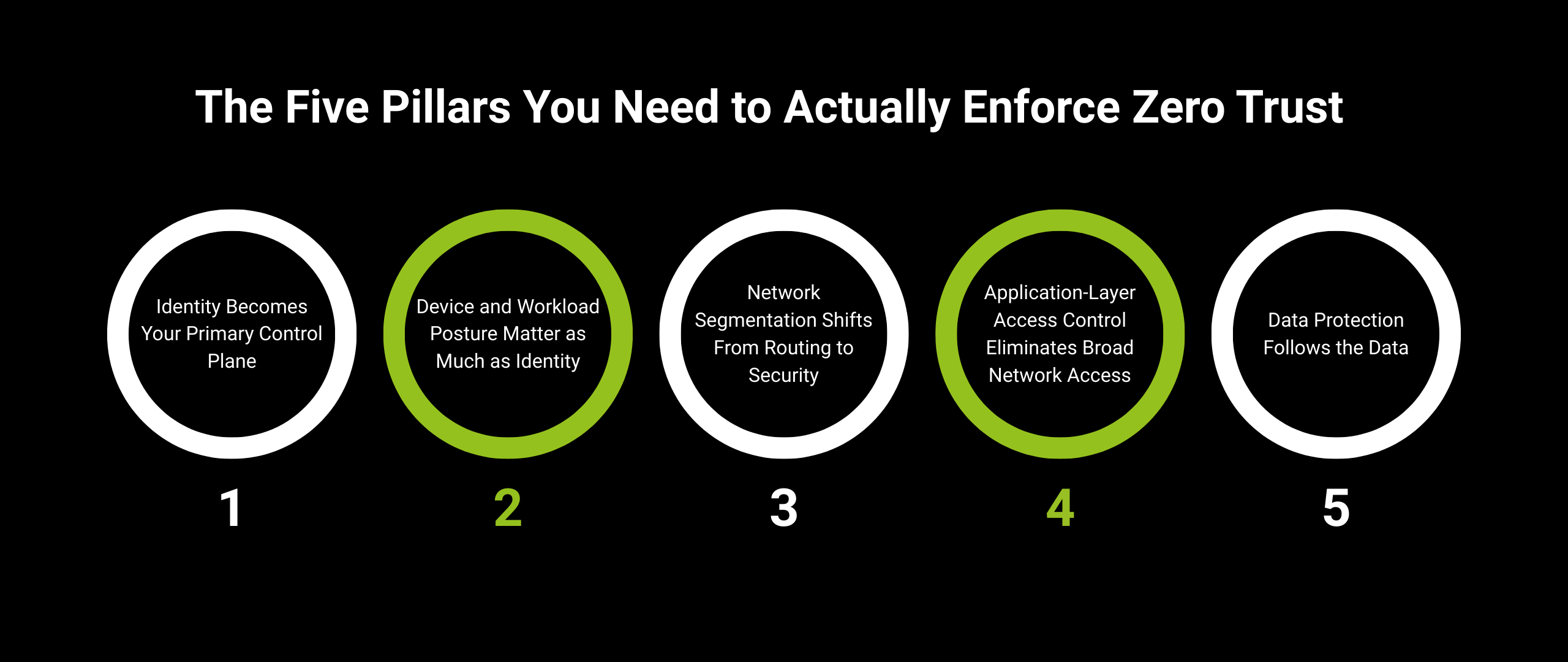
1. Identity Becomes Your Primary Control Plane
Everything in modern Zero Trust security revolves around identity. Not just human users—service accounts, APIs, containers, workloads, everything that requests access to anything needs a verifiable identity.
NIST SP 800-207 defines Zero Trust Architecture as "continually authenticates and authorizes the identity and security posture of each access request." Identity forms the foundation of Zero Trust.
This means you need strong identity providers, consistent multi-factor authentication, and lifecycle management that prevents privilege creep. But more importantly, you need visibility. If you can't answer "who or what accessed which resource, when, and under what conditions," then identity is a blind spot, not a control mechanism.
2. Device and Workload Posture Matter as Much as Identity
Knowing who's requesting access isn't enough. You need to know the state of whatever is presenting that identity.
For endpoints, this means checking OS version, patch status, and security agent health before granting access. For workloads, it means using workload identity—cryptographically verifiable identities assigned to services instead of long-lived static credentials.
Workload identity is critical for securing service-to-service communication in cloud and containerized environments. It eliminates the need for hardcoded secrets and significantly reduces the blast radius when a workload is compromised.
3. Network Segmentation Shifts From Routing to Security
Traditional networks were designed to maximize connectivity. Zero Trust flips that priority: segmentation becomes a security boundary, not just a routing decision.
The key is controlling east-west traffic—the communication between services and workloads inside your environment. This is where attackers move laterally after initial compromise, and it's where traditional security models provide almost no defense.
Microsegmentation and software-defined enforcement let you apply granular policies that scale with dynamic infrastructure. Organizations implementing proper microsegmentation can reduce lateral movement risk by 80% or more during attacks.
4. Application-Layer Access Control Eliminates Broad Network Access
Zero Trust moves enforcement from the network layer to the application layer. Instead of granting users access to entire network segments, you use identity-aware proxies and Zero Trust Network Access (ZTNA) to connect specific users to specific applications.
This eliminates the traditional VPN model where successful authentication gives you broad network access. The shift is significant: 65% of organizations plan to replace VPN services within the year, and 56% reported VPN-exploited breaches in 2024.
5. Data Protection Follows the Data
At the end of the day, attackers are after your data. Zero Trust extends all the way to the data layer through classification, encryption, and policy enforcement that follows the data regardless of where it lives.
Data-centric protection ensures that even if upstream controls fail, the data itself remains protected. Access policies stay with the data as it moves across systems and environments.
In Part 2, we'll show you exactly how to implement these pillars in hybrid environments, avoid common mistakes, and measure what actually matters.
Need help turning Zero Trust from strategy to reality? Business Technology Architects specializes in designing and implementing Zero Trust architectures that actually work in complex, hybrid environments. With over 500 successful security implementations and deep expertise across healthcare, manufacturing, and financial services, we help organizations move from conceptual frameworks to working security controls.
Our approach combines architectural expertise with hands-on implementation experience. We're certified Cisco MINT partners, but our solutions are tool-agnostic—we focus on what works for your specific environment and objectives, not on promoting specific vendors.
Whether you're starting with identity modernization, network segmentation, cloud security, or a comprehensive Zero Trust transformation, we can guide you from assessment through deployment and ongoing optimization.
Contact BTA to discuss your Zero Trust architecture: https://gobta.com/contact-us/