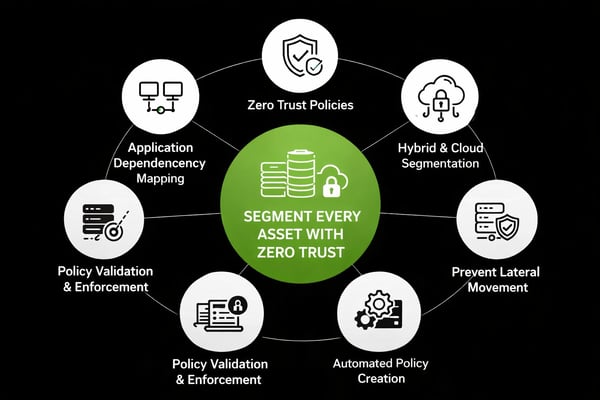
Once attackers gain access to a network, lateral movement becomes the fastest path to critical systems. Zero Trust segmentation limits this risk by isolating workloads and controlling how assets communicate.
BTA helps organizations implement segmentation strategies that reduce attack surface and prevent threats from spreading.
Zero Trust Segmentation
Common Segmentation Challenges & How BTA Helps
Segmenting every asset can feel complex, especially in environments where applications, infrastructure, and services are tightly interconnected. BTA helps organizations implement segmentation strategies that reduce risk while maintaining operational stability.
Map workload communication using application dependency analysis
Identify required traffic flows between applications and services
Model segmentation policies based on real workload behavior
Policy Design and Enforcement
Define segmentation policies aligned with Zero Trust architecture
Validate policies through staged rollout and testing processes
Deploy segmentation controls without disrupting applications
Operational Complexity
Provide architectural guidance for Zero Trust segmentation initiatives
Align segmentation policies with existing operational processes
Deliver training and mentoring for internal security teams
Policy Lifecycle Management
Maintain segmentation policies as applications and infrastructure evolve
Automate policy validation across workloads and communication paths
Simplify policy updates across dynamic application environments
Policy Automation Engine (PAE)
Automate segmentation policy creation across applications and services
Validate policy changes before enforcement across the environment
Maintain consistent policy enforcement across evolving infrastructures
Ongoing Security Operations
Monitor workload communication and segmentation effectiveness
Generate policy insights and operational security reporting
Support teams through managed services and operational guidance
"BTA's approach to implementing Zero Trust has been transformative. The team not only helped us meet cyber insurance requirements but educated our staff throughout the process. Their mentoring approach means we're not just compliant—we're confident in managing our security infrastructure."
- IT Director, Fortune 500 Manufacturing Company
How We Deliver Segmentation Solutions
Segmenting every asset requires the right combination of architecture, automation, and operational alignment. BTA helps organizations implement and sustain Zero Trust segmentation through flexible service models.
Consulting & Advisory
Assess your environment, identify segmentation opportunities, and develop a Zero Trust architecture aligned with business and security objectives.
Managed Services
Maintain segmentation policies through continuous monitoring, automated policy validation, and operational support.
Deployment
Implement segmentation controls across workloads and applications using proven deployment frameworks and automation tools.
Optimization
Refine policies, eliminate unnecessary communication paths, and improve segmentation accuracy over time.
Enablement
Accelerate segmentation initiatives through BTA’s S.I.M.P.L.E. methodology and guided Quickstart programs.
Mentoring
Provide hands-on training so internal teams can confidently manage segmentation policies and automation tools.
Why Partner with BTA for Zero Trust Segmentation?
Measurable Results: Organizations implementing segmentation significantly reduce lateral movement risk and improve visibility into workload communication.
Deep Security and Infrastructure Expertise: BTA brings extensive experience implementing Zero Trust architectures across complex enterprise environments.
Automation-Driven Approach: The Policy Automation Engine enables scalable segmentation by automating policy creation, validation, and enforcement.
Flexible Delivery Models: From consulting and deployment to managed services and enablement, BTA adapts to each organization’s operational needs.
FAQs
What does “segment every asset” mean in a Zero Trust architecture?
Segmenting every asset means controlling how workloads, applications, and infrastructure systems communicate with each other. Instead of allowing broad network access, segmentation policies ensure that each system can only connect to the services it actually needs. This reduces the attack surface and prevents attackers from moving laterally if a system is compromised.
How does segmentation help stop lateral movement during an attack?
Lateral movement happens when an attacker gains access to one system and then moves to others inside the network. Segmentation limits this by controlling which systems can communicate with each other. If policies are enforced correctly, a compromised server cannot reach unrelated applications, databases, or infrastructure services. This helps contain the attack and significantly reduces the potential impact.
Where should organizations start when implementing segmentation?
Most organizations begin by segmenting high-risk areas of the environment. Common starting points include internet-facing workloads, critical applications, shared infrastructure services, and administrative access paths. By focusing on these areas first, organizations can reduce risk quickly while building a segmentation framework that can expand across the environment over time.
What role does automation play in segmentation?
Segmentation policies must evolve as applications and infrastructure change. Automation helps teams manage this complexity by generating policies from real communication patterns, validating changes before enforcement, and maintaining consistent controls across environments. BTA’s Policy Automation Engine helps simplify this process by automating policy creation, validation, and enforcement.
How long does it take to implement segmentation in an organization?
The timeline depends on the size and complexity of the environment. Many organizations begin seeing results within a few weeks by starting with a focused segmentation initiative. Over time, policies can expand across additional applications and infrastructure systems as the segmentation strategy matures.
Ready to Segment Every Asset?
Let’s discuss how BTA can help you implement Zero Trust segmentation and protect workloads across your entire environment
Schedulle a Call Today
Insights & Resources
Explore our latest insights, industry trends, and resources on Security, Automation, and Networking.
.png?width=225&height=90&name=Logos%20BTA%20(500%20x%20200%20px).png "Logos BTA (500 x 200 px)")
.png)
.png)







-2.png)
-1.png)